About Me

My photo
Greetings. I am the Illusive One. For many years now I have been a huge video game player, movie viewer, and book reader. For almost as long, I have been a critic of these things and many people respect my opinions of these things and have often said I belong on G4 doing reviews on X-Play or a similar show. Sadly that is not likely to happen. So instead I shall do reviews for you, uninfluenced by other reviewers, of video games books, movies, and, occasionally, music and political actions. I hope you find this informative and helpful. Thank you for your time.

Tuesday, January 18, 2011

Last Argument of the Kings Review

            Well, it's time for me to give you my take on the last book in the First Law Trilogy.  It's the Illusive One's review of Last Argument of the Kings.
            Like the previous two books, this one has three different storylines.  The war continues to rage in the north and has slowed to a stalemate.  After returning from his journey west, Logan Ninefingers has returned to the north to settle some unfinished business with the King of the North, Bethod, his oldest friend and his oldest enemy.
            The second deals with Jezal dan Luthar, who, after returning from his journey west, has decided that soldiering, adventuring, and winning glory is too painful an undertaking.  Unfortunately for him, the Magi Bayaz has not yet finished with Luthar and glory has a nasty habit of sneaking up on a man when he least expects it.
            In the third, Superior Glokta has returned to the Union and once again finds himself trying to prove Bayaz is a fake.  Unfortunately for him, he has too little time and too many masters who all are at each other’s throats and sooner or later, Glokta will have to pick a side.
            While all of this is going on, the King of the Union lies on his deathbed, the peasant’s revolt and the nobles scramble to steal his crown.  None of them seem willing to believe that the shadow of Gurkish invasion is about to fall on the Union and only Bayaz knows how to stop it.  But there are risks and there is no risks greater then breaking the First Law.
            Like the previous installments in First Law, I have next to nothing bad to say about this book.  The characters come into full circle, the battles are just as epic as ever, it had a lot of dark humor, and there were so many twist that my head just kept on spinning during the last quarter of the book.  If I had any criticism with this book, it's that their seemed to be too many battles in it and this dominates most of the book.  It also left a few things hanging and there were a few characters whose fates you weren’t sure of and it made the ending a little frustrating.  On a final note, this was the book where Bayaz was revealed to be the villain he is, and if you read this book you will find out why he is my number one villain.
            Unfortunately this review and my first two don't give the books justice.  So check them out and enjoy them.

All Around
10/10


Saturday, January 15, 2011

Before They Are Hanged Review

           Within a year of the release of The Blade Itself, its sequel, Before They are Hanged was released and this was where the series really got good.
            Like the previous book, it follows along three different storylines that deal with the characters that were introduced in The Blade Itself.  The first of these deals with Logan Ninefingers, Jezal dan Luthar, Ferro Maljinn, and Bayaz as they journey west to retrieve a weapon that will allow Bayaz to defeat his rival who threatens the Union Government.  In order to find this they must cross the anarchic territory of the Old Empire, through warring factions, ancient cites full of monstrous creatures, and across freezing and barren mountains.  The biggest problem, however, is that they all hate each other and it's up to Logan to try to form some kind of fellowship between the three before they all kill each other out of ignorant, bigoted hatreds.
            The second deals with Collem West, now a Colonel in the Union Army, as he tries to keep the Union army from falling apart in the war with the barbarian North Kingdom.  With him is a band of barbarian champions once led by Logan Ninefingers, a few clans of disgruntled barbarians who have no love for their king and army of raw solders who have no experience fighting in the north.  Against him, is an entire army of battle harden barbarians with unnatural creatures supporting them and a seemingly invincible giant fighting as their champion. 
            The third deals with Glokta who has been promoted to Superior Inquisitor of Dagoska; a fortress city on the edge of the Gurkish Empire.  He is assigned to discover what happened to the previous Superior while trying to repair and defend the city from an inevitable invasion by the Gurkish Empire and root out spies within.
            All around, it was a great improvement over The Blade Itself.  Abercrombie quickly rooted out the problems that existed in it, gave more depth to the characters and made the battles more epic in scale and I have nothing negative to say about it.  So check it out after you read The Blade Itself.

All Around
10/10

Thursday, January 13, 2011

The Blade Itself Review

            Throughout my reviews, particularly with my fantasy book reviews, I have referenced an obscure fantasy series, known as the First Law Trilogy and its stand alone sequel, Best Served Cold by freelance film editor Joe Abercrombie.  His new book, The Heroes, is due for release later this month, and I thought that this would be an appropriate time to do a review on these books.  The first of these will be The Illusive One's review of The Blade Itself.
            I was first introduced to this series in September of 2009, when an acquaintance referred them to me, describing the protagonists as villains but ones you quickly grow attached to.  Over a year later, I now consider Abercrombie to be the greatest fantasy writer since Tolkien.
            The first of these books revolves around three central characters whose lives are about to be made extremely difficult by the Magi Bayaz.  The first of these characters is the barbarian, Logan Ninefingers.  With all of his friends and family apparently dead and banished from the recently formed North Kingdom, Logan is just trying to survive with enemies all around him and can only hope his luck holds out until he can join Bayaz for whatever task he wants him for.  He comes off as being the world weary veteran of the characters, who is no longer interested in glory but just wants to survive, even though fighting is all he knows. 
            The second of these characters, (and my personal favorite of the three), is Sand dan Glokta, an Inquisitor of the island based nation, known the Union.  During the first half of the book, Glokta attempts to convict a tax evading trading company of treason and will do all he can to achieve this goal.  During the second half, Glokta is assigned to prove that Bayaz is not the Magi he claims to be and finds his life greatly changed as a result. 
            He is a difficult character to describe.  Originally a war hero, Glokta was severely crippled after a battle with a middle-eastern type empire, known as the Gurkish Empire and was captured and tortured for two years.  He emerged from that war severely crippled, unable to walk straight and states that uncomfortable is as good as it gets for him.  He uses what he learned from his time being tortured for the Inquisition for no reason other than he has nothing else better to do with his life.  He is a character you try to be sympathetic with, but find it difficult because of the line of work he is in and he shows no empathy for it.
            The last of the major characters is nobleman Jezal dan Luthar.  Up until this point, his life had consisted of a cushy desk job in the army, seducing women of the common class, ripping his friends off in games of poker, and training for a dueling completion.  This guy is the most unlikable of the three and is a complete ass.  Like many other nobles of fiction, he believes he is superior to everyone in a lower class then he, is a dick to all those around him, including those who consider him a friend, and throughout the entire book you want to see Logan beat the shit out of him or Gloka torture him.
            Their were also a number of noteworthy supporting characters including Major Collem West who is the closest thing to a good man in this series.  Born a commoner, West rose through the ranks of the Union army after winning a dueling completion and becoming a war hero in the same war that crippled Glokta and was a formally his best friend.
            Their was also Ferro Maljinn, a psychotic woman and former slave who seeks vengeance on the Gurkish Empire  who is introduced during the second half of the book.  Other than that, nothing much is revealed about the character other then she is a skilled fighter.
            The only real criticism I have with this book is that it doesn’t reveal much in plot and it ends with the country going to war and gives no clue as to where the series is heading.  Other than that, it was all great.  I found the characters realistic, extremely complicated and were in no way the usual cookie cutter, two dimensional characters you see in most fantasy books.  The dialogue was realistic, believable, and continued cursing, which you never see in fantasy.  Last to address are the fight scenes in the book.  Like the characters and dialogue, they are realistic, believable, and above all, bloody with the characters getting exhausted and wounded.  You'd be surprised how rare that is in a fantasy book as well.
            All around, however, this book was easily the worst of Joe Abercrombie’s books and obviously the work of an amateur author but that's not saying much.  It's absolutely worth reading and from this point, the books just kept on getting better.
All Around
8.5/10

Monday, January 10, 2011

Dead Space Review

          As I mentioned in my Nightmare on Elm Street Remake Review, the horror genera in film is one that has grown stale in recent decades, although there are a few good ones if you look in the right place.  But I've found that the future of horror is not in films, but in video games, particularly in the survival horror genera.  Unfortunately, this is also a genera that has become stale and is now a dying breed of video games.  The one game series, however, that may be able to revive it is the Dead Space series.  With the release date of Dead Space 2 rapidly approaching, I decided this would be a good time to do a short look at the first game.  Unfortunately, I haven’t played this game in a while so this review won't be as detailed as most.  It's my Review of Dead Space.

The Plot
            The game takes place in the distant future where Earth's resources have been depleted.  In order to keep humanity alive, huge ships, known as planet crackers go out into space to strip mine other planets on a huge scale, destroying them in the process.  When the planet cracker U.S.H. Ishimura goes dark, a small team of military personal, technologists, and an engineer is sent to investigate.  You play as the engineer, Isaac Clarke who's looking for his girlfriend aboard the ship but instead finds grotesque, monstrous creatures known as necromorphs and you are forced to fight your way through hordes of these creatures in order to survive. 

The Game Play
      The game play is like that of most survival horror games; over the shoulder, third person with limited health and ammo that are both easy to lose.  Rather than shooting the crap out of things to kill them, however, killing enemies relies on how well you can dismember their limbs.  Never before or after have I played a game where you could blow the head off an enemy and still have it keep coming after you.  The main weapons you use, however, are mostly space age tools, and are often more useful then guns.  Much of the game is dimly lit which gives it a creepy and disturbing environment where you have no idea when something is going to pop out and try to kill you.  Unfortunately the necromophs tend to pop out in the exactly same kind of places which causes the game to get a little repetitive.   

The Characters
            The characters are what you would expect in this kind of game.  Isaac is a silent, mostly faceless protagonist so he doesn’t have much to offer.  One interesting thing to note about the character, however, is that he frequently sees images of his girlfriend on monitors of computers and sees here running around the ship and one can't help but wonder if he actually is seeing her, or if he is just going insane.  Zach Hammond is your typical leader of the survival horror situation who tries to get a grip on things but constantly finds things out of his control.  Doctor Terrence Kyne is your typical scientist who wants to fix everything and Dr. Challus Mercer is the kind who wants the necromorphs to spread out of some insane religious belief.  The last character to mention is Kendra Daniels who doesn’t seem to have any other purpose then to guide Isaac.  All around, the characters are just what you would expect in a survival horror, B-Movie type piece of media.

The Verdict
            When the game came out, I loved it.  It was creepy, it was frightening, it was gore filled, and more than once made me jump out of my skin.  But at the same time, it suffered from clichéd characters, repetitive, slow paced game play, and a forgettable final boss fight.  But all around, I still consider it one of the, if not the best survival horror games of this era of gaming.
All Around
8.5/10

Monday, January 3, 2011

Apocalypse Now

            Let me start off by saying Happy New Year to all and to start off this year, I shall be reviewing one of my favorite films of all time.  This is the Illusive One's review of Apocalypse Now.
            Released in 1979, Apocalypse Now is a Vietnam War Epic, directed by Godfather director Frances Ford Coppola and starring Martian Sheen, Marlin Brando, Robert Duvall, and Dennis Hopper.  The film is more or less a Vietnam War era retelling of the classic 1902 novella, Heart of Darkness by Joseph Conrad and centers around an army assassin named Captain Willard (Sheen), as he tracks down renegade Colonel Kurtz, (Brando), up the fictional Nung River at the height of the Vietnam War.  The film also contains a brief appearance by Harrison Ford as an officer who gives Willard his assignment and early roles for now famous actors like Laurence Fishburne and R. Lee Ermey.
            On the positive side on this film...well what isn't good about this film?  For starters the casting was perfect.  Martin Sheen was phenomenal as Willard and this was easily his best role ever.  He also serves as the film's narrator which gives you a view into the psychology of the character and gives a surreal quality to the film.  Equally as great, (but for some reason more famous), was Marlin Brando as Colonel Kurtz who delivers some of the most haunting monologs on war ever to be seen on film.  Robert Duvall was morbidly hilarious as Lt. Colonel Kilgore and Dennis Hopper was great as the crazy, hippie, unnamed photojournalist. 
            As a whole, the film has a great surreal and psychological quality to it, that gets under your skin and into your head in a way no other film does.  That aside the film can also be enjoyed for its individual scenes.  Whether it’s Kilgore's raid on the Vietcong controlled village, the Playboy show at the river dock, the boat inspection gone terribly wrong, the Vietcong attack on the Do Long Bridge, the Vietcong attack on the boat, Kurtz's raid of the boat, Kurtz's monologue to Willard, or the climax of the film there's something in it for anyone to enjoy.  After each of these events Willard narrates his own take on them with a passive onlooker's stance before the film moves on, giving these scenes, which would be normal in any other film, a surreal quality to it that gets into your head.
            The directorial style and post-production editing of the film was also great.  The film editing and the way it combined different camera angles into a single view was perfect.  The sound editing and visual effects were top notch and still holds up to anything they have out today and were actually better then a lot movies that came out in the decade to follow.  The soundtrack of the film by The Doors worked perfectly and helps to add to the surreal quality of film.
            On the negative side...well I have absolutely nothing bad to say about it and that's all I have to say on that.
            Almost as interesting as the film was the story of its making, documented in the documentary, The Heart of Darkness: A Filmmaker's Apocalypse.  Production for the film was started in the early 70s with Coppola originally as the producer.  Friend and fellow film maker, George Lucas was originally suppose to direct but dropped out of the project after he got the go ahead for Star Wars and eventually Coppola opted to direct the film himself.
            Another issue with the film was the casting.  Originally Harvey Keitel was cast as Willard after Al Pacino and Steve McQueen turned down the role but was fired by Coppola soon after because he felt Keitel wasn't right for the part.  Eventually the part went to Sheen, who was a problem on his own.  During much of the filming, Sheen was in an alcoholic stage of his life and made filming difficult for those around him.  Sheen also suffered a heart attack during filming, which delayed the filming for several weeks. 
            Marlin Brando was also an issue for the cast.  He was cast early on by Coppola, as they had worked together in The Godfather but was nearly as much trouble as Sheen.  For the role he was paid for, at the time, an unheard of amount of 3.5 million dollars for a month’s work.  He was also suppose to be fit and in shape for the film but showed up on the set overweight.  As a result, Brando was always dressed in black and only seen in shadowed environments.
            Finally there were problems with the filming and post-production stages.  It took a total of two years to film and an additional two years of post-production before it was finally released in 1979.  It was shot in the Philippines and this caused even more problems for the already troubled film.  Bad weather constantly delayed filming and destroyed many expensive sets.  Often members of the Philippine Army would serve as extras, only to be called away to fight rebels less than a mile away from the sets.  The release date was also delayed several times, as Coppola literally had to edit through millions of feet of footage he had shot.
            It would later be said by Coppola that they had access to too much money, too much equipment and everyone went insane a little by little during its making and it nearly cost him his physical and mental health.  Despite the great many of problems the production had, much of it worked to the film's advantage and helped give it its surreal quality and when it all came together the people of the world received one of the greatest films for its time and for all time.
            The film would later be re-released in theaters in 1987 to capitalize on the success of other Vietnam War era films such as Platoon and Full Metal Jacket.  The Redux version would be released in 2001, which contained about 49 minutes more of previously unedited scenes.  While all of these scenes are entertaining, I would only recommend seeing the Redux version after you have seen the original, as they make an already long movie ridiculously long.  None of these scenes have Willard narrating and dilutes the surreal quality of the film.  And that's my take on the Redux version.           
            As you can probably tell by this review, I absolutely loved this film and I believe it surpassed anything Coppola made before or after.  If I could give it anything higher than a ten I would and if I ever made a list of my favorite films, this one would undoubtedly be very high, (if not on top), on that list..  It had phenomenal acting, a great story, and a surreal, psychological quality to it that I had never seen before or after and is the closest thing I have ever seen to a perfect film.       

All Around
10/10

Wednesday, December 22, 2010

Ben-Hur Review, Happy Holidays

            I haven't said this in my previous posts, so I'll say it now: Happy Holidays everyone.  For this occasion I decided to do a review on a film that's not quite a Christmas movie, (in fact it's more of an Easter film), but still has the same kind of feel good aura around it most Christmas movies do and often used to be shown on T.V. during the Holiday and Easter seasons.  It's time for the Illusive One's Ben-Hur Review.
            Released in 1959, the film was the most epic of its time, using over 100,000 costumes, 8,000 extras, 300 sets, and the largest budget of its time.  It was directed by William Wyler and starred Charlton Heston and was based on the novel of the same name by Lew Wallace.  The film would go on to win 11 Academy Awards, including Best Picture, Best Actor for Heston, and Best Director for Wyler and was the third Best Director win of his carrier.
            The film revolves around the story of Jewish nobleman, Judah Ben-Hur during the Biblical era.  After a cruel twist of fate and a betrayal of a once beloved friend, Judah finds all he loves taken from him, beginning his epic story that leads him to becoming a slave on Roman gallons, to a champion chariot racer, to an adopted son of a Roman noble, and finally back to Jerusalem where he seeks vengeance against his former friend and hopes to be reunited with his true friends and family and to fateful encounters with Jesus Christ that change his life.
            On the positive side...well...nearly everything about it is good.  It's well acted, has a great plot, and for its time had great production value with a lot of great scenes, most famous being the climactic chariot race and cleverly blended the story of Jesus with that of Ben-Hur.  While the plot may seem a little clichéd by today's standards it didn't come off that way at all.  Ben-Hur's character is dynamic and great and throughout the entire movie, you find yourself hoping he will win in the end, but also want him to find the peace that has eluded him since the start of the film. 
            On the negative side, however, the film is a bit outdated.  Most of the costumes, particularly the Roman armor, the ships, special effects and most of the fights look really bad and fake by today's standards.  A few I remember in particular are a man who climbs out of a ship with his hand missing with what looks like a piece of plastic sticking out of the stub and another where a man starts tearing his skin trying to get a chain off.  But those are the only complaints have.  Everything else is great.
            All around, this was a great movie, and I would highly recommend it to anyone.  It's a great story of a man who has the world, looses it, only to gain it back again in a different form, learning something along the way.  Maybe it's not a Christmas movie but it's still a great feel good movie so check it out. 
All Around
9.5/10
            Until next time, this is the Illusive One saying Happy Holidays.               

Tuesday, December 21, 2010

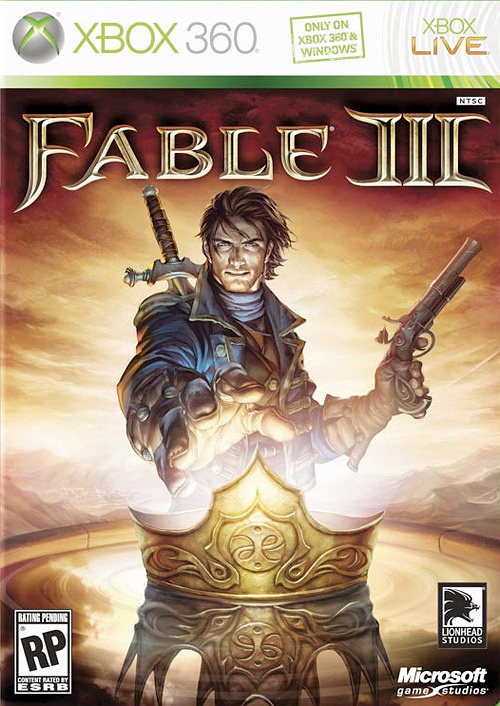
Fable 3 Review

          Throughout October, I reviewed a number of games in preparation for the late releases this year.  Earlier I did Fallout: New Vegas, but now it's time to do another.  This is the follow up to Fable 2.  It's the Illusive One's Fable 3 review.

The Plot
            The game begins roughly fifty years after the end of Fable 2 and Albion has entered the Age of Industry.  After defeating Lord Lucian, the hero from Fable 2 unites all of Albion under his/her rule and becomes king/queen.  The hero from the last game is now dead and his/her eldest son, Logan, is now ruler of Albion.  At first he is a fair but firm ruler, but almost overnight becomes a tyrant and the people suffer under his harsh rule.  It opens with a cinematic that explains the entire situation in the land that depicts a chicken running through the streets of Bowerstone.  You play as the Prince or Princess, Logan's younger sibling, who, after being forced into a terrible situation by Logan, start a revolution against him to place yourself as the ruler of Albion.  After obtaining the throne, however, you find that your promises are harder to keep when Albion faces one of its greatest threats of all time.
The Game Play
            For the most part, the game play of Fable 3 was identical to Fable 2.  The controls were the same, your dog did the same things, you're still able to buy and sell property, and most of the enemies were the same as they were in Fable 2. 
            One major change in the game was the way you upgraded your character.  All of the other Fable games had your character go into an upgrade menu, where you spent strength, skill, will, and general experience for new abilities.  In this game, however, in order to upgrade your character you need to go to a surreal area called The Road to Rule, where you find chests along a path that upgrade your skills.  Rather than using experience, you use these things called Guild Seals to unlock the chests that are earned through combat, missions, and obtaining friendships with people in the world.       
            Another change was the way you used spells.  In previous Fable games the ability to cast spells seemed to be innate, but in this game, the Hero must use a gauntlet in order to channel the power.  The number of spells you are able to use has also been reduced and I and many people I know were disappointed by this. 
            One irritating thing about this game is the enemies and let me tell you, they got lazy in this department.  They are almost the exact same as those of Fable 2; bandits, (though they call them mercenaries), Hobbs, Balverines and hugely overused Hollow Men.  While they did include a few new enemies that come from a desert land they don't really do anything to lift the problem, as they only appear sparsely and only in certain areas at certain times of the game.
            The jobs in this game have also changed.  In Fable 2 you could be a bounty hunter, an assassin, a black smith, a bar tender or a wood cutter.  In this game however, only the bounty hunter and black smith jobs return and adds in the jobs of a lute player and a pie maker.  The way you do the job has also changed into a button sequence rather than hitting the A button at certain times and I thought it was a great improvement. 
            The game also includes more cut scenes than in previous games.  But they and many other parts of the game were very glitchy, as trails of the characters seemed to be left behind as they walked and made playing it nauseating.  Often when getting a critical hit, the camera would remain zoomed in on the enemy in question making you open to enemy attacks.  Even the trails leading to your destinations were glitchy; often disappearing or leading you to God knows where and made the game infuriating.
             The last thing to mention in this department is the karma system.  While there are decisions to make early in the game, the major ones don't start until you become the ruler of Albion.  They mostly have to deal with the promises you made to the people who supported your rebellion and whether or not to keep them.  In the end, you can either become the tyrant you fought to overthrow, or become the greatest ruler Albion has ever known.
The Characters
            Unlike the characters in Fable 2, the characters in this game were flat and extremely forgettable.  Walter is your typical mentor, Jasper is your typical supportive butler and the rest were just as clichéd.  Even the antagonists were boring and forgettable, although it did have a decent final boss fight. 
            Reaver returns in this game as the head of a company called Reaver Industries and is your typical evil CEO and I found it a bit disappointing that you never get the chance to fight him.  Theresa is also back, once again as a kind of guide to the Hero but her involvement is minor and disappointingly lazy.  Even the dog in this game was downgraded and wasn't nearly as charming or entertaining as it was in Fable 2.
            This game was also the first to give the Hero a voice.  But the Hero hardly has any lines and the voice acting for him/her is so bad that it makes you wish they never gave him/her a voice in the first place.  All around, the characters were a big disappointment. 
The Verdict
            All around, I enjoyed this game much more then Fable 2.  The characters and upgrade system went down, the enemies remained the same but the plot was by far greater.  There was just as much, if not more, to nitpick at as Fable 2, and it was still no where nearly as good as the original Fable, it was still, in my opinion, a much better sequel then Fable 2.
All Around
8/10